For operators who need an ultrafine grinding mill for 2500 mesh, the first technical requirement is simple: the equipment must generate and classify powder with a D97 value around 5 microns while maintaining useful throughput and stable operation. Liming Heavy Industry Co., Ltd. has developed the MW Micro Powder Mill specifically for this demanding range. This mill, a medium-speed micro-grinding unit that absorbs advanced Swedish grinding technology, can be adjusted from 325 mesh to 3250 mesh. Its D97 ≤ 5 μm capability places 2500 mesh well within the recommended process window. With an input size of 10–20 mm and a capacity range of 0.5–25 t/h, the MW mill is designed for medium-scale ultra-fine powder lines producing calcium carbonate, gypsum, non-metallic mineral powders, and pulverized coal preparation. Its pulse-jet dust collector and closed-circulation air system make it a cleaner alternative to older ultra-fine grinding systems.
Liming Heavy Industry Co., Ltd. was founded in 1987 and has grown into a modern joint-stock enterprise integrating research, manufacturing, and sales. The company’s headquarter is located in the HI-TECH Industry Development Zone of Zhengzhou, covering 80,000 m², with another manufacturing workshop in Shangjie Industry Park covering 67,000 m². Over the past 30 years, Liming has applied modern scientific management, precision manufacturing, and continuous innovation to become a well-known supplier in domestic and international machinery manufacturing. The MW Micro Powder Mill is one of the company’s core products for ultra-fine powder processing.
What does 2500 mesh actually mean for powder quality?
Mesh size is a traditional measurement of sieve openings per inch. At 2500 mesh, the nominal opening is approximately 5 microns. In practice, industrial ultra-fine grinding uses the D97 value rather than a single sieve size: D97 ≤ 5 μm means 97 percent of the particles are below 5 microns. For applications such as coated paper, plastics, paints, rubber fillers, and flue-gas desulfurization, this level of fineness increases surface area and improves reactivity, while also requiring good particle-size distribution control. A mill that can reach the top speed but with broad distribution will create agglomerates, poor brightness, or inconsistent viscosity. The MW Micro Powder Mill is built to maintain a controllable distribution in the 325–3250 mesh range, which makes it suitable for 2500 mesh products or finer grades.
Working principle of an ultrafine grinding mill for 2500 mesh
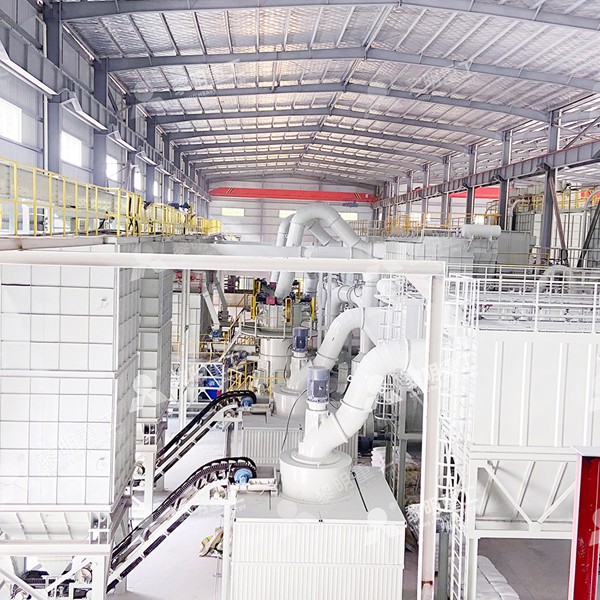
The MW Micro Powder Mill uses a medium-speed grinding mechanism that combines crushing, shearing, and classification in one system. The main motor drives the main shaft and each turnplate through a reducer. The reducer then drives dozens of rollers to rotate against a raceway on the grinding ring through pins. Feed material, after being crushed to 10–20 mm, is conveyed by a bucket elevator to a hopper and then fed evenly by a vibrating feeder to the central part of the upper turnplate. Under centrifugal force, the material moves to the edge and falls into the gap between the rollers and the ring raceway. The rotating rollers crush and grind the particles against the ring, producing fine powder. An upward air flow carries the powder to the separator. Oversized particles return to the grinding zone, while particles that pass the separator are collected as finished product. The air then returns to the blower in a closed loop, minimizing dust emission.
For 2500 mesh output, the classifier speed and air-flow settings are adjusted so that only particles with the proper size can leave the mill. This classification step is critical. If the classifier is set too coarse, the product may contain too many large particles. If it is set too fine, capacity drops dramatically. The MW mill allows operators to tune the finished fineness between 325 mesh and 3250 mesh, giving the flexibility to produce 2500 mesh at a practical capacity while preserving a consistent particle-size distribution.
Applications of a 2500 mesh grinding system
- Ground calcium carbonate for paper coating, paints, plastics, rubber, and sealants.
- Gypsum powder for construction materials, industrial fillers, and soil conditioners.
- Non-metallic mineral powders such as barite, kaolin, talc, and limestone for desulfurization.
- Pulverized coal preparation for industrial boilers and power plants where ultra-fine coal improves combustion efficiency, with appropriate safety design.
- Chemical and building-material industries that require dry ultra-fine powders with stable particle size.
Because the MW Micro Powder Mill is a dry grinding system, it avoids slurry handling and dewatering steps. The closed circuit and pulse dust collector also help maintain a clean working environment, which is increasingly important for environmental compliance.
Selecting an ultrafine grinding mill for 2500 mesh
Not every grinding mill can economically make 2500 mesh. Liming’s Raymond Mill, for example, outputs fineness between 613 μm and 44 μm, which is approximately 28–325 mesh. The MTW European Type Trapezium Mill is suited to coarse-to-medium powder and typically serves limestone desulfurization and heavy calcium carbonate production, but it is not the primary choice for 2500 mesh. The LM Vertical Roller Mill and Ball Mill can produce fine powders, but their systems often need external classification to reach ultra-fine grades. The MW Micro Powder Mill is the product in Liming’s line-up that directly lists 325 mesh to 3250 mesh as its operating range, making it the natural match for 2500 mesh projects.
When evaluating an ultrafine grinding mill for 2500 mesh, the key variables are:
- Feed size: The MW mill accepts 10–20 mm feed, so upstream crushing must reduce larger ore to this range.
- Hardness and abrasiveness: Softer minerals such as calcium carbonate and gypsum are ideal. Materials harder than about Mohs 7 may cause high wear and are better handled by other technologies.
- Moisture: For dry ultra-fine grinding, moisture should generally be kept below 6 percent to prevent clogging and classifier inefficiency.
- Target fineness and particle size distribution: Confirm that D97 ≤ 5 μm is the required specification, and set the classifier accordingly.
- Capacity: The MW mill covers 0.5–25 t/h; actual throughput depends on the feed material and the exact 2500 mesh product specification.
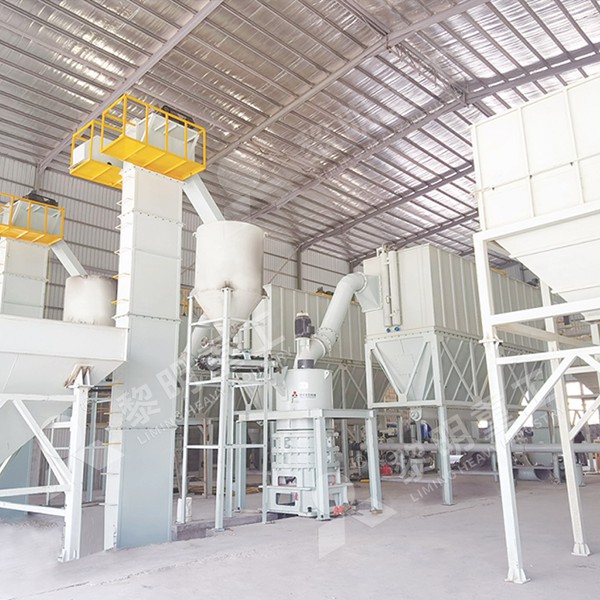
Liming Heavy Industry’s engineering team can help customers test representative material samples, determine the correct mill size, and design a complete line including crusher, elevator, feeder, mill, dust collector, blower, piping, and control panel. This system-level approach avoids the common problem of buying a good mill but building a poor powder-processing circuit around it.
A complete 2500 mesh powder production circuit
An ultrafine grinding mill for 2500 mesh does not operate alone. In a typical Liming system, raw material passes through a jaw crusher or hammer crusher until it is below 20 mm. A bucket elevator lifts the crushed material into a hopper. A variable-frequency vibrating feeder delivers the material uniformly to the MW mill. Inside the mill, the grinding and classification process takes place. Fine powder leaves the mill with the air stream and is recovered by a cyclone or bag collector. A pulse-jet dust collector cleans the exhaust air before it is recycled or released. The entire system can be controlled from an electric cabinet, with automatic feeding and interlock protection to maintain stable operation. This closed-loop design reduces material loss, dust emissions, and operator intervention.
Operational tips for 2500 mesh ultra-fine grinding
- Maintain consistent feed rate: Fluctuating feed causes mill vibration and unstable fineness.
- Check classifier parts regularly: Worn vanes change the particle-size distribution.
- Monitor roller and ring wear: As grinding surfaces wear, output and fineness can drift.
- Keep the dust collector in good condition: The pulse-jet cleaning system prevents pressure buildup and product loss.
- Sample and test fineness: Use a lab sieve or laser particle analyzer to confirm D97 at regular intervals.
- Avoid moisture spikes: Wet feed can blind the mill and classifier, reducing throughput.
Conclusion
Ultrafine grinding to 2500 mesh requires more than a high-speed mill; it requires a balanced combination of grinding force, internal classification, dust control, and system engineering. Liming Heavy Industry’s MW Micro Powder Mill provides this combination with a tested design, D97 ≤ 5 μm capability, adjustable 325–3250 mesh fineness, and a capacity range useful for many industrial powder producers. With the company’s 30-year manufacturing background, large production bases in Zhengzhou, and a focus on research-driven innovation, the MW mill is a credible, professional answer for operators looking to produce 2500 mesh powder with stable quality and lower environmental impact.
Frequently Asked Questions
1. Can an MW Micro Powder Mill really produce 2500 mesh?
Yes. The MW Micro Powder Mill has an adjustable fineness range of 325 mesh to 3250 mesh, and its D97 ≤ 5 μm performance places 2500 mesh within the recommended operating window. Actual results depend on the feed material, moisture, and classifier settings.
2. What is 2500 mesh in microns?
2500 mesh corresponds to approximately 5 microns. A D97 of 5 μm means that 97 percent of the particles in the finished powder are smaller than 5 microns, which is a common quality target for ultra-fine non-metallic mineral powders.
3. What feed size is required before entering the ultrafine grinding mill for 2500 mesh?
The MW Micro Powder Mill accepts an input size of 10–20 mm. Larger materials must first be crushed by a jaw crusher, hammer crusher, or similar equipment. Stable feeding is important for maintaining the target fineness and capacity.
4. What materials can be processed at 2500 mesh?
The MW mill is widely used for calcium carbonate, gypsum, non-metallic ores, and pulverized coal preparation. As with most dry grinding systems, the material should be non-explosive and have low moisture. Liming’s engineers should confirm suitability for specific materials.
5. How is the MW Micro Powder Mill different from a Raymond mill for 2500 mesh work?
Raymond mill output fineness is generally 613 μm to 44 μm, which is about 28–325 mesh. It is not designed for 2500 mesh. The MW Micro Powder Mill is engineered for ultra-fine powders from 325 mesh to 3250 mesh, so it is the appropriate choice for 2500 mesh production.


