Summary: For paper coating, kaolin is an engineered pigment. It gives coated paper its gloss, opacity, ink holdout, and print smoothness. But kaolin only delivers those benefits when the particle size distribution, shape, and brightness have been developed by the right grinding system. A kaolin grinding mill for paper coating must generate a high proportion of submicron particles, remove coarse tailings, avoid iron contamination, and still operate at a practical capacity. At Liming Heavy Industry, we have spent more than 30 years building dry grinding equipment for non-metallic minerals, and this article explains how our LM vertical roller mill, MTW European-type trapezium mill, MW micro powder mill, Raymond mill, and ball mill can be configured into a coating-grade kaolin processing line.
Why kaolin is chosen for paper coating
Kaolin is a natural clay composed mainly of kaolinite. Its platy particle shape is particularly valuable in paper coating. When the plates align on the paper surface, they create a smooth, evenly reflective layer that improves gloss and print definition. Coated paper also needs controlled porosity, and kaolin fines help seal the base sheet so that printing ink stays on the surface instead of being absorbed unevenly.
However, the same useful properties can become defects if grinding is not correct. Oversized particles scratch the coating during calendering, reduce gloss, and create print voids. Excessive ultrafine particles increase binder demand and can make the coating slurry too viscous. For this reason, a coating kaolin specification often states that at least 60 to 90 percent of the particles must be below 2 µm, with a maximum top cut of 10 µm. The grinding mill must therefore produce not simply a fine powder, but a calibrated particle size distribution.
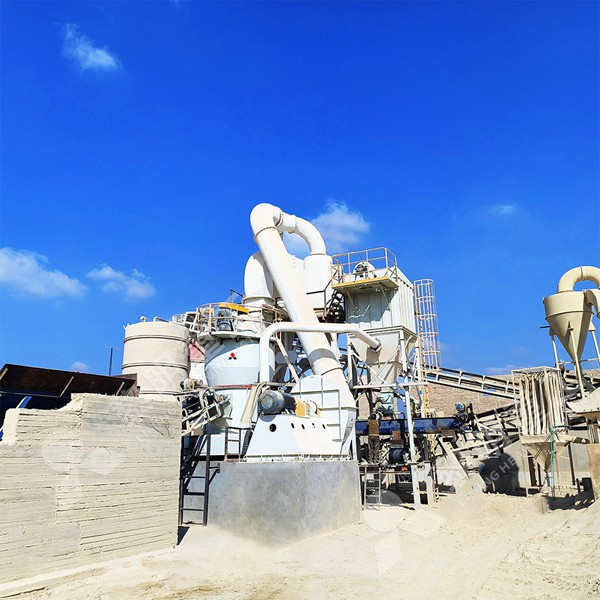
Key grinding equipment for kaolin
No single machine solves every kaolin challenge. Feed size, moisture, capacity, target fineness, and existing plant layout all influence the choice. At Liming Heavy Industry, we usually advise customers to think in stages: first reduce the kaolin to a manageable powder, then refine it to coating-grade fineness.
Raymond Mill
Our Raymond mill is a reliable entry-level machine for kaolin drying and medium-fineness grinding. It accepts feed sizes of 15 to 25 mm, has a capacity of 1.2 to 4.5 t/h, and produces fineness between approximately 613 µm and 44 µm. This range is suited to filler-grade kaolin, agricultural carriers, or pre-ground feed for a finer second-stage mill. It is designed for non-flammable and non-explosive materials below 7 on the Mohs hardness scale with less than 6 percent moisture, which covers most kaolin applications. It is simple to operate and has been the workhorse of many small mineral powder plants.
MTW European Type Trapezium Mill
The MTW European-type trapezium mill is the next step up. It is the upgrade of the traditional Raymond mill and pendulum mill, using patented technology to improve grinding pressure, separation efficiency, and output. With a capacity of 3 to 55 t/h and an input size of 30 to 50 mm, it fits medium and large dry grinding lines. The system includes a grinding mill, separator, air blower, jaw crusher, vibrating feeder, hopper, dust collector, pipe, powder collector, electric cabinet, and motors. The air flow is recycled in a closed system, and a pulse dust collector controls emissions. For kaolin, the MTW is often used to produce 200 to 400 mesh powder, which can then be fed into a micro powder mill for coating-grade particles.
LM Vertical Roller Mill
When production reaches several tons per hour and the raw kaolin contains more moisture, the LM vertical roller mill deserves attention. It integrates drying, grinding, powder selection, and conveying in one unit, and handles 10 to 400 t/h with feed sizes of 30 to 55 mm. The vertical mill uses a roller-on-table grinding bed, and hot air can be passed through the mill to lower the kaolin moisture while grinding. For companies that must process high-moisture kaolin or run a very large industrial-mineral plant, this machine provides stable operation and lower unit energy consumption. It is especially effective in non-metallic mineral, coal, and slag preparation lines.
MW Micro Powder Mill
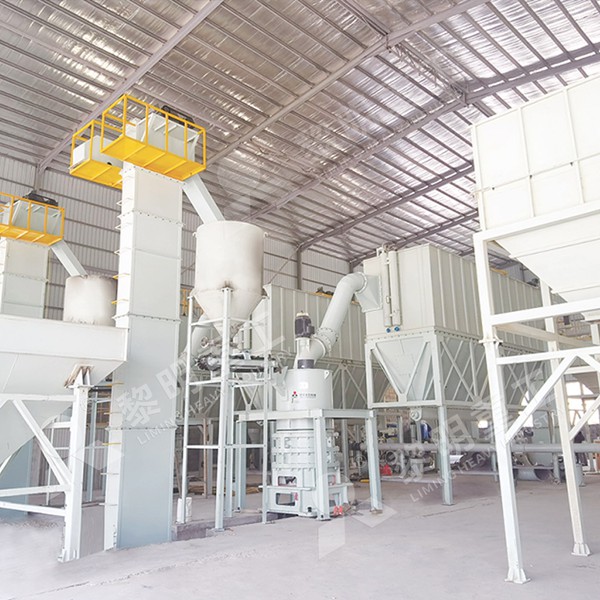
The MW micro powder mill is the closest match for coating-grade kaolin. It is a medium-speed micro-grinding mill that absorbs advanced Swedish grinding technology and is specifically designed for superfine powder. Its fineness can be adjusted between 325 mesh and 3250 mesh, and the finished product can reach d97 ≤ 5 µm. The feed size is 10 to 20 mm, and capacity ranges from 0.5 to 25 t/h depending on the target fineness and kaolin hardness. In this mill, the main shaft drives a turntable, while dozens of rollers are pressed against the grinding ring. The final powder is carried upward by air flow, and the separator returns oversized particles for another pass. The system is equipped with a pulse precipitator, so fine kaolin is collected without polluting the plant environment.
Ball Mill
The ball mill remains a common grinding machine in mineral processing and can handle kaolin as well. It has a capacity of 0.65 to 50 t/h and accepts feed sizes up to 25 mm. For paper coating, a ball mill usually needs to be combined with an external air classifier to remove coarse particles. It is more flexible for wet grinding routes, but when dry grinding is preferred, the MW micro powder mill often provides a more direct path to the sub-10 µm range with lower installed power.
Building a coating-grade kaolin grinding line
In my experience working with mineral processing plant managers, the most successful lines are those that think in stages. A practical kaolin grinding line for paper coating can be arranged as follows. First, raw kaolin is crushed by a jaw crusher to a size below the mill feed specification. The crushed material is conveyed to a hopper and then fed with a variable-frequency belt feeder into the grinding machine. If the kaolin has high moisture, an LM vertical roller mill can perform simultaneous drying and grinding; otherwise the MTW or Raymond mill is sufficient for the primary stage. The coarse powder from the primary mill is sent to the MW micro powder mill. Inside the MW mill, kaolin is ground between rollers and ring, carried upward by airflow, and classified by the separator. Coarse particles fall back to the grinding zone; the fine delivered powder is collected in a pulse dust collector and transported to a product silo. The air returns to the blower in a closed circuit, which reduces dust emissions and makes the plant easier to permit.
Process and quality considerations
Coating kaolin needs more than a fine d50. The distribution must be steep, with very few coarse particles above 5 to 10 µm. Our MW mill's internal separator can be adjusted while the machine is running, giving operators control over the top cut. For a particularly demanding coating formulation, an external high-efficiency classifier can be added to tighten the distribution further.
Brightness is another issue. Grinding equipment must not introduce iron or other color-damaging contamination. Regular inspection of grinding rollers and rings, plus a well-maintained magnetic separator in the feed line, helps protect kaolin brightness. Moisture control is also important because a wet powder may plug the air classifier and dust collector. The LM and MTW systems, with their integrated drying and closed-loop airflow, provide a stable thermal environment that keeps the final moisture below the target level.
Finally, energy and wear. Coating-grade kaolin grinding is energy-intensive. The vertical roller mill and MTW mill use grinding forces more efficiently than a simple impact mill, and their internal classification avoids over-grinding the fine fraction. For plants that already own a mill, our engineers can assess whether adding an MW micro powder mill or upgrading the classifier is more economical than replacing the entire system.
Conclusion
Kaolin for paper coating is not a commodity clay; it is a high-value engineered pigment. The right grinding line must control particle size, preserve brightness, handle moisture, and operate cleanly. With the MTW European-type trapezium mill and LM vertical roller mill for primary grinding, the MW micro powder mill for superfine finishing, and the Raymond mill and ball mill for special cases, Liming Heavy Industry can provide a process that meets coating paper mills' strict standards. Whether you are expanding an existing plant or building a complete kaolin grinding workshop, the key is to match the mill to the product schedule and the particle size curve your coating formulation demands.
Frequently Asked Questions
- Can a kaolin grinding mill from Liming produce the particle size needed for paper coating? Yes. The MW micro powder mill can produce fineness between 325 mesh and 3250 mesh, with a final product at d97 ≤ 5 µm. When combined with proper classification, this satisfies the ultrafine requirements of coating-grade kaolin.
- Which mill should be used for raw kaolin with high moisture? The LM vertical roller mill is the best choice because it integrates drying, grinding, powder selection, and conveying. Hot air inside the mill evaporates moisture while the kaolin is being ground, so you avoid handling sticky wet clay in separate drying equipment.
- What capacity ranges are available? The Raymond mill has a capacity of 1.2 to 4.5 t/h, the MTW trapezium mill 3 to 55 t/h, the LM vertical mill 10 to 400 t/h, the MW micro powder mill 0.5 to 25 t/h, and the ball mill 0.65 to 50 t/h. The best choice depends on your required output and target fineness.
- How do you prevent oversized particles in the final kaolin powder? The MW micro powder mill and MTW mill both use a separator in a closed air loop. Particles that do not pass the separator are returned to the grinding zone and ground again. An additional external classifier can be installed to tighten the top cut for coating formulations.
- Is the dry grinding process environmentally friendly? Yes. The systems are equipped with pulse dust collectors and use closed-loop air circulation. This recovers fine kaolin, reduces dust emissions from the workshop, and complies with modern environmental protection requirements.


