Across the rubber industry, dolomite powder has become more than just a filler. It can reduce raw material cost, improve processability, and reinforce the final rubber compound when the particle size and distribution are controlled. The key is consistent powder quality. Liming Heavy Industry's LM vertical roller mill, applied as a dolomite vertical mill for rubber, combines drying, grinding, classifying, and conveying in one automatic system. This article reviews the role of dolomite in rubber, the common problems in powder production, the technical features of our vertical mill, and the process route we recommend for rubber-grade dolomite powder. Five practical FAQs are included at the end.
Why Dolomite Powder Is Important in Rubber Products
Dolomite is a calcium-magnesium carbonate mineral. In rubber compounding, finely ground dolomite acts as a functional filler. It helps rubber products keep their shape, increases hardness and modulus, and improves resistance to heat and weathering. The magnesium content in dolomite gives it a slightly different behavior compared with normal calcium carbonate, which can be useful in certain formulations. Because dolomite powder can be processed to a light color, it is also suitable for light-colored rubber products such as seals, hoses, mats, and shoe soles.
Rubber manufacturers usually require dolomite powder with a strict top-cut particle size, stable specific surface area, and low moisture. If the powder contains coarse particles, the finished rubber surface may be rough and mechanical properties may decline. A pulverizer must therefore be reliable enough to keep producing fine powder, hour after hour.
Problems Faced in Dolomite Powder Production
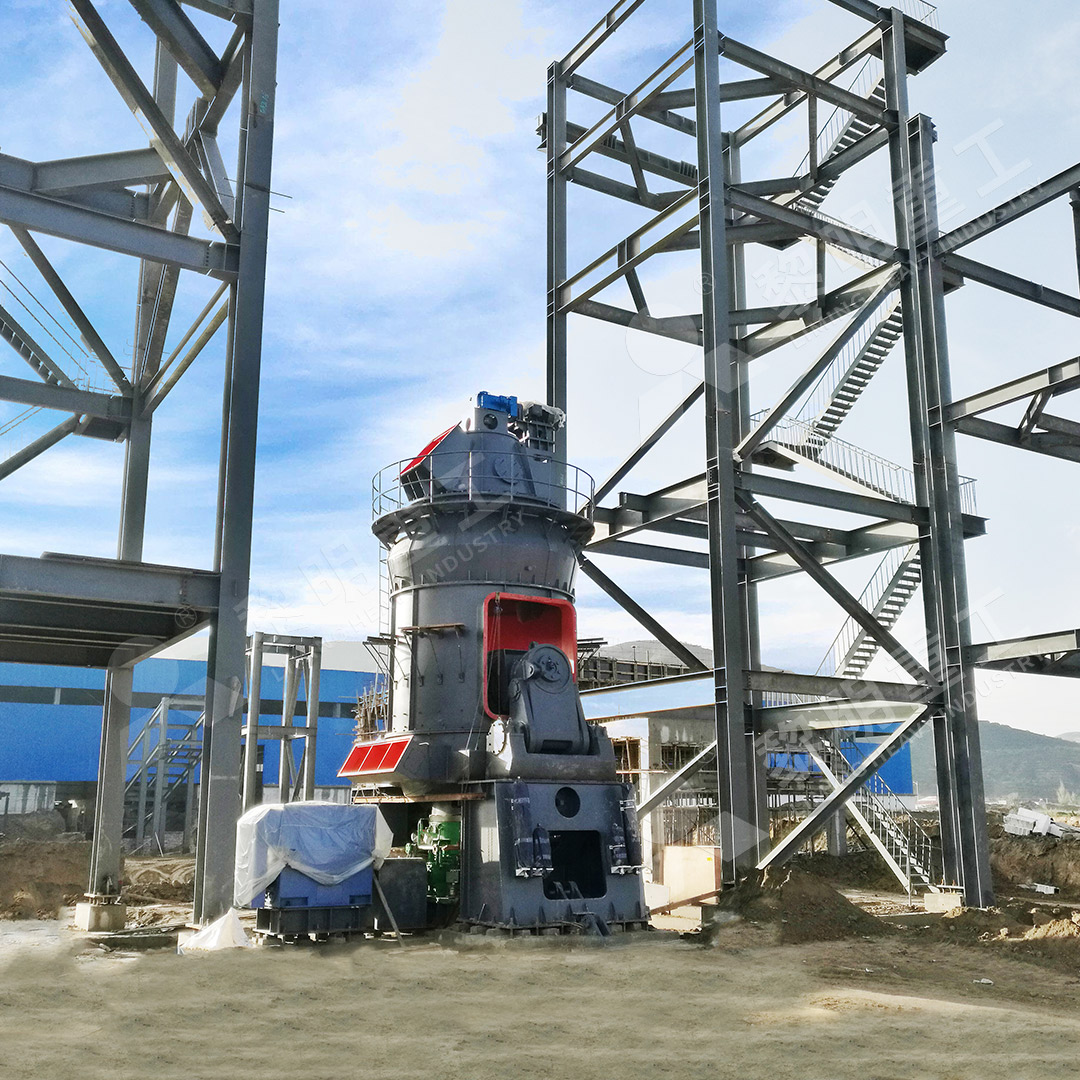
Traditional grinding equipment often struggles with dolomite. A standard ball mill can reach the desired fineness, but it consumes more energy and produces a wider particle size distribution. An ordinary roller mill may be easy to operate, yet many roller mills need frequent maintenance when grinding hard dolomite. Some mills also require separate drying equipment because moist feed blocks the classifier or causes bag filters to blind. Operators then have to manage multiple machines and more variable product quality. This is why many plants are moving to a vertical roller mill.
LM Vertical Roller Mill: A Better Dolomite Vertical Mill for Rubber
Liming Heavy Industry designed the LM vertical roller mill to solve these problems. The LM series adopts a new milling device and an automatic electric control system. It integrates drying, grinding, powder selection, and conveying. For non-metallic minerals, coal, and slag, the machine has become a central piece of modern powder plants. When used as a dolomite vertical mill for rubber, it combines high capacity with stable fineness. Depending on the model, the LM vertical mill can process 10 to 400 t/h of material, with feed sizes from 30 to 55 mm. This makes it suitable for medium and large scale rubber powder producers.
I recall a customer from the rubber auxiliaries sector. They had been using an older mill originally designed for coal, not carbonate minerals. Their powder became coarser after every few shifts. After changing to our LM vertical roller mill, the fineness stayed inside the target range during a 72-hour trial. The plant manager was surprised by the low vibration and the clean working environment. That experience is common: a dolomite vertical mill for rubber should be designed with the material in mind, not adapted from another industry.
Main Advantages of Using Our Dolomite Vertical Mill for Rubber
- Integrated drying: hot air enters the mill to remove surface moisture and assist classification. This avoids the need for a separate dryer.
- High efficiency: material bed grinding consumes less energy than impact grinding. The mill also uses hydraulic pressure to control grinding force.
- Precise classification: the variable-speed separator controls fineness at the outlet, allowing adjustments for different rubber recipes.
- Automatic control: relevant process parameters are monitored and adjusted automatically, reducing product deviation.
- Compact and clean: fewer pieces of equipment and a closed system reduce dust emission and simplify installation.
How the Dolomite Vertical Mill Works in a Rubber Powder Plant
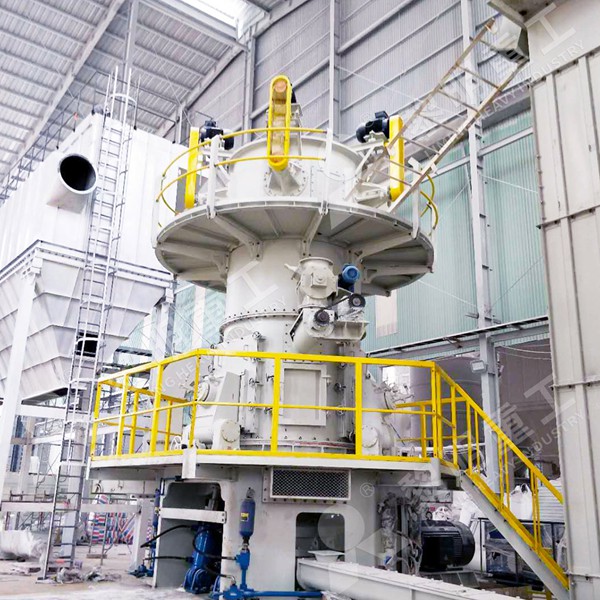
Imagine a complete process for producing rubber-grade dolomite powder. First, a jaw crusher reduces dolomite ore to sizes within 30-55 mm. The crushed material enters the vertical mill through a vibrating feeder. Inside the mill, the grinding rollers press the material against a rotating grinding table. The material is crushed and ground until it is fine enough to be carried upward by the hot gas flow. A dynamic separator at the top rejects coarse particles, sending them back to the grinding table for another pass. Fine particles leave with the gas stream and are collected in a bag filter. Because the system is under negative pressure, dust is largely contained.
The automatic electric control system adjusts the feed rate and separator speed. This helps keep the product size stable even if the raw dolomite has small changes in hardness or moisture. For a rubber plant, this stability is essential. A slight change in filler particle size can change the viscosity of the compound and the final mechanical properties of the part.
Process Design and Service Support from Liming
Liming Heavy Industry Co., Ltd. was founded in 1987. It is a modern joint-stock corporation with research, manufacturing, and sales in one organization. The headquarter is located in the HI-TECH Industry Development Zone of Zhengzhou, covering 80,000 m2. A second workshop in Shangjie Industry Park covers 67,000 m2. Over the past 30 years, we have emphasized scientific management, precision manufacturing, and innovation. We also follow a strategy that connects scientific research with production. For a customer who wants a dolomite vertical mill for rubber, this means more than a single machine. We can provide process design, installation guidance, commissioning support, and operator training.
Because dolomite is a non-metallic mineral with abrasive characteristics, the selection of wear parts and the mill settings should be based on test data. Our team can evaluate raw material samples and recommend a suitable LM model. The goal is to give you a powder line that runs continuously, produces the fineness your rubber compound needs, and keeps maintenance costs predictable.
Frequently Asked Questions
- Can the LM vertical mill process dolomite for rubber? Yes. The LM vertical mill is suitable for non-metallic minerals such as dolomite. You can adjust classifier speed and operating parameters to produce fine powder that meets rubber filler requirements.
- What feed size does the dolomite vertical mill accept? The LM vertical mill can accept feed sizes between 30 and 55 mm. If the mined dolomite is larger, it should be pre-crushed with a jaw crusher.
- Does the mill need a hot air system? The vertical mill can be equipped with a hot air furnace or use waste heat to dry and convey materials. The integrated drying function handles moderate surface moisture of dolomite.
- What capacity is possible? Depending on the model and material properties, the LM vertical mill can produce 10 to 400 t/h. That range makes it possible to select a size for small pilot lines or large industrial plants.
- Is the LM vertical mill stable for continuous rubber powder production? Yes. Its automatic control system, enclosed grinding area, and optimized roller settings reduce vibration and downtime. Regular maintenance is still required, but the design is built for continuous operation.


